
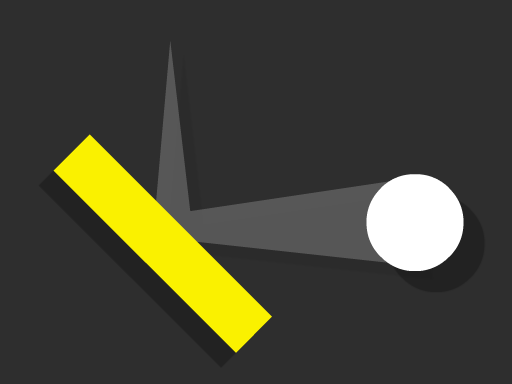
Arcade game
Yellow Lines
Minimal avoidance where the hazards are lines rather than objects. Reading a line means reading its whole length, not its nearest point.
- Difficulty
- Moderate
- Platform
- Modern browser
Game overview
Line-based avoidance games strip the genre back to geometry. Instead of discrete obstacles you get moving or rotating lines, and the difference matters: a line has extent, so the part of it that will hit you is often not the part you are watching. Players who track the nearest edge get clipped by a section further along that swept into their position. The correct habit is to look at the gap you intend to occupy and check whether any part of any line will pass through it, which is a spatial reading task rather than a reaction task. Because the visual language is so sparse, mistakes are always attributable.
This title is best suited to players who like abstract, geometry-driven avoidance with no visual clutter.
How to play Yellow Lines
- Move to avoid contact with the lines as they rotate or slide across the field.
- Read the whole length of a line, not the end nearest to you.
- Choose the space you intend to occupy and verify nothing will sweep through it.
- Make small continuous adjustments rather than darting between positions.
Controls
- Move the mouse, drag, or use arrow keys to reposition
Objectives and failure conditions
Objectives
- Survive as long as possible
- Keep to spaces that will still be clear a moment from now
The run ends or fails when
- Any contact with a line ends the attempt
- Being caught by a section of a line you were not tracking
Gameplay mechanics
- Extended line hazards rather than point obstacles
- Rotation and translation producing swept areas
- Continuously increasing line count or speed
- Minimal visuals, making the geometry entirely legible
Tips for Yellow Lines
- The part of the line that kills you is usually not the part you were watching. Track lines whole.
- Aim for where you want to be in a second, not where is clear now.
- Small movements. Darting across the field is how you cross a line you had already avoided.
What worked well and what did not
Pros
- Extremely legible — every death is clearly your own spatial misread
- The sparse presentation keeps attention entirely on the mechanic
Cons
- Minimal visuals also mean minimal variety across a session
- At high line density the survivable space can effectively disappear
Player comments
No published comments yet.