
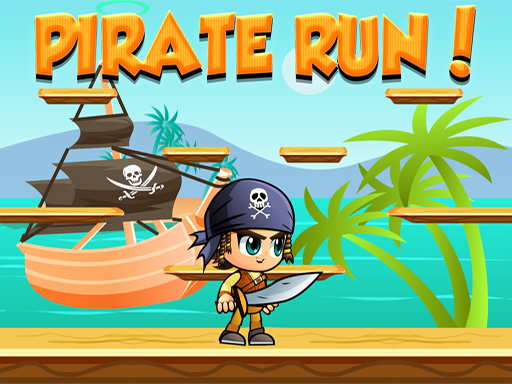
Arcade game
Pirate Run
A lane-based endless runner where the obstacles arrive faster than you can react — so the skill is pattern recall, not reflexes.
- Difficulty
- Moderate
- Platform
- Modern browser
Game overview
Lane runners look like reaction games and stop being them fairly quickly. Obstacle sequences are drawn from a limited set of patterns, and past a certain scrolling speed there is genuinely not enough time to see an obstacle and decide; you are recognising a shape you have met before and executing a remembered response. That is why players plateau at a score and then jump past it suddenly — they have learned a new pattern. Collectibles are usually placed along the safe path, which makes them a navigation hint as much as a score bonus, and following the coins is often more reliable than reading the obstacles directly.
This title is best suited to players who enjoy building pattern recognition and chasing an incremental distance record.
How to play Pirate Run
- Switch lanes and jump to avoid obstacles as the level scrolls toward you.
- Follow the coin trail — collectibles usually mark the safe route through a pattern.
- Learn the recurring obstacle groups; at high speed you are recalling, not reacting.
- Commit to one lane rather than hovering between two, which is where most collisions happen.
Controls
- Left and right arrows or swipes to change lane
- Up arrow, Space, or swipe up to jump
Objectives and failure conditions
Objectives
- Run as far as possible before colliding
- Collect coins, which double as a guide to the safe path
The run ends or fails when
- Hitting any obstacle ends the run immediately
- Being caught mid-lane-change when an obstacle arrives
Gameplay mechanics
- Discrete lanes rather than free movement
- A finite library of obstacle patterns that repeat
- Continuously increasing scroll speed
- Collectible placement that signals the intended route
Tips for Pirate Run
- Watch the coins, not the obstacles. They are laid along the safe line and are easier to read at speed.
- Hovering between lanes is the most common death. Pick a lane and be fully in it.
- When you plateau, you are missing one specific pattern. Notice which obstacle group keeps ending your runs rather than trying to get generally faster.
What worked well and what did not
Pros
- Discrete lanes make inputs unambiguous, so deaths feel fair
- Pattern learning gives a clear route to improvement beyond raw reflex
Cons
- Single-hit failure at high speed can feel abrupt
- The pattern library is finite, so runs eventually become repetitive
Player comments
No published comments yet.