
Clicker game
Rock Paper Scissors-3
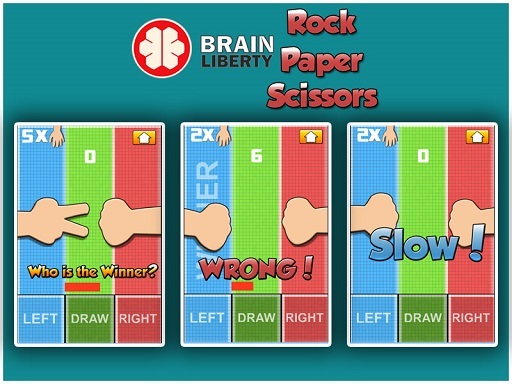
Rock paper scissors against an opponent that is looking for patterns. Your job is not to guess well but to be unguessable.
- Difficulty
- Easy
- Platform
- Modern browser
Game overview
The interesting thing about a digital rock-paper-scissors is that it exposes how bad humans are at randomness. People avoid repeating the same throw, cycle in predictable orders, and over-correct after a loss — and any opponent tracking frequencies will exploit all three. So the skill is not prediction, it is self-management: throwing in a way that has no structure, including being willing to repeat the same option three times in a row, which feels wrong and is exactly why it works. Over a long enough series, an opponent with no pattern to find converges on a draw, which is the correct target against a pattern-matching AI.
This title is best suited to players who want something instantly playable, and anyone curious how poorly humans generate randomness.
How to play Rock Paper Scissors-3
- Choose rock, paper, or scissors each round.
- Do not avoid repeating yourself — repeats are part of genuine randomness.
- Ignore your previous result. Over-correcting after a loss is the most exploitable habit there is.
- If the opponent starts winning consistently, you have developed a pattern rather than had bad luck.
Controls
- Click or tap your chosen throw
Objectives and failure conditions
Objectives
- Win more rounds than the opponent across the series
- Avoid producing a detectable pattern
The run ends or fails when
- Losing the round series
- Falling into a predictable sequence the opponent can exploit
Gameplay mechanics
- Simultaneous-choice resolution with fixed win relationships
- Opponent frequency tracking that punishes patterns
- Series scoring rather than single decisive rounds
- No skill expression beyond the randomness of your own choices
Tips for Rock Paper Scissors-3
- Repeat throws deliberately. Avoiding repetition is the most common and most readable human tell.
- A losing streak means you have a pattern, not bad luck. Change how you decide, not what you pick.
- Against a pattern-matcher, a draw is a good result. Aiming to win consistently means introducing structure.
What worked well and what did not
Pros
- Instantly understood with zero learning cost
- The self-randomisation problem is genuinely more interesting than it first appears
Cons
- No mechanical depth — the game cannot be played better, only more randomly
- Outcomes feel arbitrary in short series
Player comments
No published comments yet.