
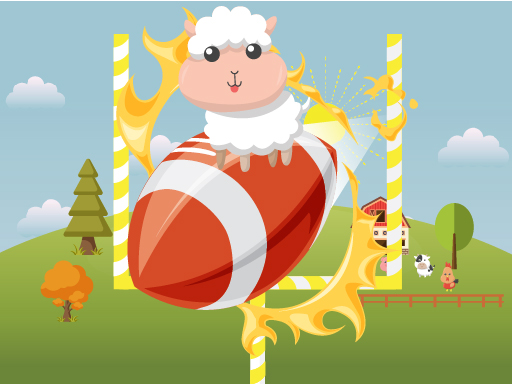
Sport game
Animals Rugby Flick
Flick kicking through posts where the target moves further away rather than getting smaller. Elevation is the variable to master.
- Difficulty
- Easy
- Platform
- Modern browser
Game overview
Flick-kicking games ask for one gesture and then scale the difficulty by distance. What makes them more interesting than they look is that distance does not simply require more power — it changes the required elevation, because a flatter trajectory loses height too early and a steeper one loses range. Getting a long kick through the posts means finding the elevation that maximises distance for a given power rather than just swiping harder. Where wind is modelled, it introduces a lateral offset that is constant per attempt and therefore compensable, which turns a miss into precise information about the next attempt.
This title is best suited to players who like a measurable aiming skill they can refine attempt by attempt.
How to play Animals Rugby Flick
- Flick or swipe to kick; the gesture direction sets elevation and its length sets power.
- For long kicks, adjust elevation rather than only adding power.
- Compensate for wind by offsetting your aim laterally by a proportional amount.
- Treat each miss as a measurement and adjust one variable on the next attempt.
Controls
- Swipe or drag and release to kick
Objectives and failure conditions
Objectives
- Kick successfully through the posts from increasing distances
- Reach the round target score
The run ends or fails when
- Missing the posts wide or short
- Failing to reach the score threshold for the round
Gameplay mechanics
- Single-gesture control combining elevation and power
- Distance scaling that changes optimal elevation rather than just power
- Wind offset that is constant within an attempt
- Round-based score targets rather than continuous play
Tips for Animals Rugby Flick
- Long kicks need a different angle, not just a harder swipe. Elevation is the variable most players never adjust.
- Wind is a fixed number per attempt. Offset by a consistent amount and your accuracy improves immediately.
- Change one thing per attempt. Adjusting power and angle together tells you nothing about either.
What worked well and what did not
Pros
- The elevation-versus-power relationship is a real technique worth discovering
- Attempts are quick, so learning is fast
Cons
- Swipe precision limits how finely you can control elevation
- Rounds add distance without adding new ideas
Player comments
No published comments yet.