
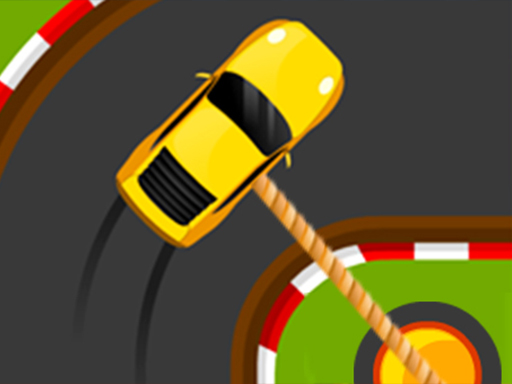
Racing game
Sling Drift Online
Cornering by tether. You attach to a post, swing around it, and let go — the entire game is release timing.
- Difficulty
- Moderate
- Platform
- Modern browser
Game overview
Sling Drift replaces steering with a grappling mechanic. Holding down attaches your car to the nearest pivot and it arcs around that point; releasing sends it off on a tangent. So you are not turning a wheel, you are choosing an exit angle, and the exit angle is a consequence of when you let go. Hold too long and you swing back across the road; release early and you carry straight into the outside wall. Speed climbs continuously, which compresses the release window rather than changing the technique — the correct release point stays in the same place relative to the corner, you just have less time to find it.
This title is best suited to players who want a single-input skill game with an unusual control idea at its centre.
How to play Sling Drift Online
- Hold to attach to the pivot as you approach a corner, release to break away.
- Release when the car is pointing down the next straight, not when it feels like enough turn.
- Do not tap. A partial hold produces a shallow arc that leaves you mid-road with no pivot in range.
- Accept that speed only shrinks your window — the release point itself does not move.
Controls
- Hold mouse, screen, or Space to attach; release to detach
Objectives and failure conditions
Objectives
- Chain corners without leaving the track
- Survive as the scroll speed increases
The run ends or fails when
- Leaving the road on either side of a corner
- Missing the pivot entirely and continuing straight off the track
Gameplay mechanics
- Tether-based cornering instead of directional steering
- Tangential exit determined purely by release timing
- Continuously rising speed that narrows the input window
- Pivot points placed at fixed positions relative to each corner
Tips for Sling Drift Online
- Look at where your nose is pointing, not at the corner. The nose tells you when to let go.
- Half-holds are the worst outcome available — commit fully or not at all.
- When speed ramps up, do not change your release point. Trust the same visual cue and react sooner.
What worked well and what did not
Pros
- A genuinely unusual cornering mechanic that feels distinct from any steering model
- One input means failures are unambiguous
Cons
- Late-game speed makes the window narrow enough to feel arbitrary
- Only one type of corner, so variety is limited to pacing
Player comments
No published comments yet.